
Self Storage Roofing in Lexington, KY from Commercial Roofing of Lexington.
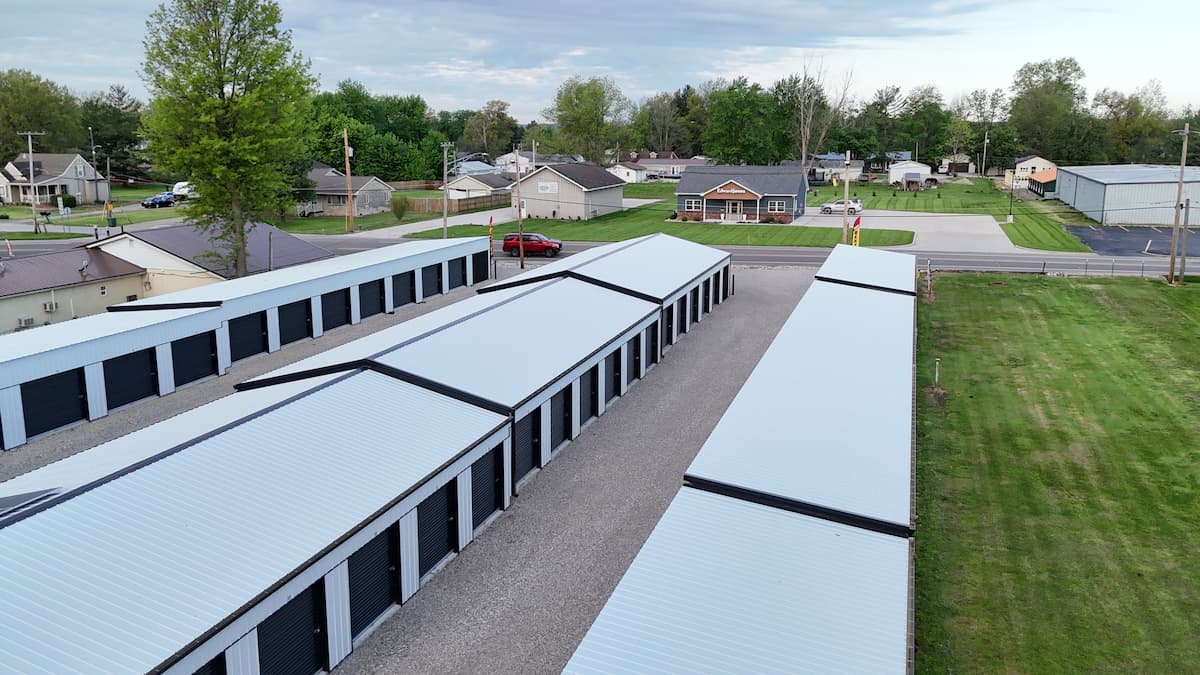
Lexington's self-storage market is driven by operators like Stor-All Lexington, whose multi-building campuses along Richmond Road and Nicholasville Road represent exactly the kind of large-footprint commercial roofing challenge that separates generalist contractors from specialists. A single Stor-All property can span 80,000 to 120,000 square feet of combined roof area across dozens of low-slope structures, and every square foot must perform reliably if tenants are going to trust that facility with furniture, documents, and irreplaceable personal property.
Large-footprint roofing on self-storage properties in Lexington demands a systems-level approach rather than a building-by-building patch strategy. When a facility owns ten or fifteen connected structures, the drainage network linking those roofs becomes as important as any single membrane. Improper slope, blocked internal drains, or mismatched expansion joints between structures allow water to pond and migrate laterally, eventually infiltrating climate-controlled units through wall penetrations that were never designed to handle hydrostatic pressure.
Tenant protection starts well before a drop of rain falls. During any re-roofing or overlay project, the occupied-operations challenge at a storage facility is real: tenants arrive at all hours, forklifts move inventory in and out, and roll-up doors cannot be blocked. A roofing crew that fails to sequence its tear-off and installation work around facility access patterns will find itself at odds with the storage operator and, worse, will expose tenant belongings to weather during an unplanned work stoppage.
Drainage engineering is where many storage roof failures originate. Kentucky's climate delivers heavy spring and summer thunderstorms capable of dropping two inches of rain in under an hour. Lexington facilities must be designed to handle that surge without allowing water to exceed the structural ponding threshold. Internal drains should be oversized for storage buildings, and overflow scuppers must be positioned and sized to provide a true secondary drainage path, not merely a code-compliance checkbox.
Membrane selection on Lexington storage properties typically comes down to TPO versus EPDM, with PVC used selectively on buildings where chemical resistance or high-reflectivity requirements justify the cost premium. TPO at 60 or 80 mil thickness has become the dominant choice on new construction and full replacements, offering strong heat-weld seam performance and Energy Star reflectivity that reduces cooling loads on climate-controlled units. EPDM remains competitive on smaller structures with complex penetration patterns, where its flexibility and forgiving installation characteristics reduce labor risk.
Penetration management is a persistent headache on storage properties because HVAC equipment for climate-controlled units, electrical conduits, and sprinkler system components all punch through the membrane repeatedly. Each penetration is a potential failure point. Properly flashed pipe boots, pitch pockets filled with appropriate sealant, and pre-manufactured curb flashings torqued to manufacturer spec are non-negotiable. On older Lexington facilities where penetration flashings have been patched and re-patched over decades, a full inventory and replacement program is often the most cost-effective path.
The business continuity dimension of storage roofing in Lexington cannot be overstated. A leak in a climate-controlled unit triggers liability claims, insurance involvement, and potential loss of a long-term tenant relationship. Storage operators in Kentucky generally carry business interruption coverage, but claims are time-consuming and deductible exposure is real. A well-maintained roof with documented inspection records is the best risk-management tool available to a storage owner.
Preventive maintenance contracts on Lexington self-storage portfolios should include bi-annual inspections, one in early spring before storm season and one in late fall before freeze-thaw cycles begin. Kentucky's temperature swings are meaningful: Lexington averages around fifteen freeze-thaw cycles per year, and each cycle stresses flashings, lap seams, and any areas where water is allowed to pond and refreeze. An inspection program that catches minor seam lifts and flashing separations before winter arrives routinely prevents five-figure emergency repairs in February.
When evaluating roofing contractors for a Lexington storage portfolio, operators should ask for references from comparable multi-building storage projects, verify that the contractor carries installation certifications from the membrane manufacturer, and confirm that the warranty offered is a true manufacturer-backed NDL (no-dollar-limit) policy rather than a contractor-only workmanship guarantee. A 20-year NDL warranty on a well-installed TPO system can outlast multiple ownership cycles and adds meaningful value to a storage property at the time of sale.
- How many square feet of roofing does a typical Lexington self-storage facility involve?
- A mid-size Lexington storage campus with 500 to 800 units typically covers 80,000 to 150,000 square feet of combined roof area across multiple structures, making it one of the largest flat-roof projects a commercial contractor will encounter in the region.
- What membrane type is best for Lexington's climate?
- 60 or 80 mil TPO is the most common choice for Lexington storage facilities, offering a balance of UV reflectivity, heat-weld seam strength, and cost. EPDM remains a strong option on older buildings with complex geometry.
- How does a storage roof project proceed without disrupting tenant access?
- Experienced contractors phase tear-off and installation to keep facility drives and unit rows open at all times, coordinate with the facility manager to identify high-traffic periods, and never leave open deck exposed overnight or during forecasted rain.
- What causes most roof leaks on Kentucky storage buildings?
- The most common failure points are deteriorated penetration flashings, blocked or undersized internal drains that allow ponding, and lap seam failures on aging single-ply membranes that have been patched rather than replaced.
- Is a manufacturer-backed warranty worth the added cost on a storage facility?
- Yes. A no-dollar-limit manufacturer warranty on a storage portfolio protects against both material defects and installation errors, and it transfers to a new owner at sale, a tangible asset that investors and lenders recognize.