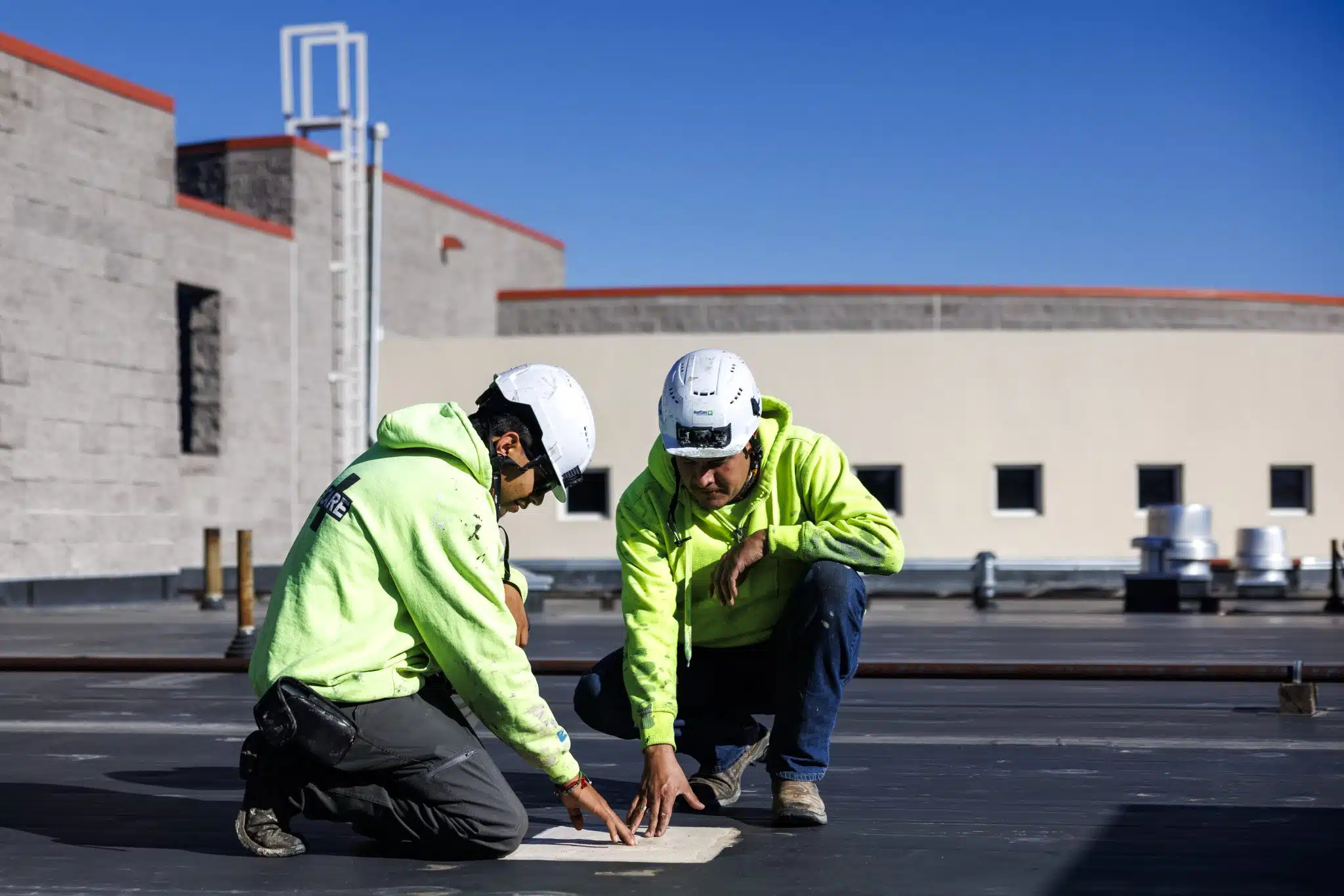
Scheduled roof service that extends membrane life and keeps capital replacement on your calendar, not the weather’s.
Nobody budgets to replace a roof at year fourteen. The membrane was sold on a twenty-year expectation, the depreciation schedule assumed it, and the capital plan penciled it in accordingly. Yet across Lexington’s commercial building stock, roofs come off early far more often than they run long — and nearly every early tear-off traces back to the same cause: years in which nobody set foot on the roof unless something was already leaking. A roof service agreement changes the ending. It commits our crew to your roof on a schedule — two rooftop service visits every year, plus a dedicated check before the cold season — so the small failures that shorten a roof’s life get corrected while they are still small.
What ages a membrane is rarely dramatic. A lap seam loses a half-inch of adhesion. The sealant in a pitch pocket checks and splits. A drain strainer packs solid with leaves from the mature trees that shade the older commercial districts, and water that should have left the roof in minutes sits on it for days. Each of those is a minutes-long correction during a service visit. Each of them ignored is how insulation gets wet — and saturated insulation is the point of no return, because once moisture is in the assembly, restoration options close and full replacement becomes the only path left.
The calendar matters here because central Kentucky’s weather works both ends of the thermometer. Before the cold arrives, agreement roofs get a pre-season pass: drains and scuppers cleared so meltwater has an exit, membrane and flashings checked before snow settles in for the season and the thaw-and-refreeze rhythm starts levering open every marginal detail. The Bluegrass pattern of thaw-and-refreeze is harder on terminations than sustained cold — water finds the gap in the afternoon and pries it wider overnight — which is exactly why the check happens before the first storm rather than after the first stain on a ceiling tile.
The two scheduled visits are working sessions, not walkthroughs. The crew walks the full field, probes seams and penetration flashings, resecures lifted edge metal, reseals terminations that have opened, clears every drain and scupper, and completes minor membrane repairs on the spot. Every visit produces a dated photo report — and that file quietly maintains the roof’s paper life alongside its physical one, because manufacturer warranties expect documented periodic maintenance, and a warranty that cannot be evidenced is a warranty in name only.
The economics are lopsided in the owner’s favor. Replacing the roof on a Hamburg-scale retail building or a Coldstream research facility is a six- or seven-figure event; a decade of agreement service costs a small fraction of that. Every year of service life the program adds is direct return — and the condition history it builds lets you take the exits that unmaintained roofs miss. A membrane that is dry, adhered, and documented at year fifteen can often take a restoration coating that buys another decade at a third of replacement cost. That option only exists for roofs whose condition is known and whose insulation stayed dry, which is precisely what the agreement protects.
Owners with several buildings — a strip on New Circle Road, offices near the university, flex space along Nicholasville Road — fold them into a single agreement with one renewal, per-roof reports, and a portfolio view of where every membrane sits in its life cycle. We also take over roofs we did not install: the first walk establishes a baseline condition record, and the roof enters the same schedule as everything else we service. Between visits, agreement holders get priority dispatch, with crews that already know the roof arriving ahead of the queue.
The starting point is one walk over your roof. We document where the system stands today, tell you honestly how much life is left in it, and put a single yearly figure on the table covering both service visits, the pre-season pass, drainage clearing, small repairs, and the full reporting file. Call 859-765-7998, and the roof you already own starts earning back years.
Questions Owners Ask
How many extra years can scheduled service realistically add?
It depends on the system, the deck, and how early the program starts, but the pattern is consistent: maintained membranes routinely meet or outrun their design life, while unmaintained ones rarely reach it. Five or more additional years is a common outcome when service starts before moisture gets into the insulation — and on replacement costs, five years is an enormous number.
Our roof is already twelve years old. Is it too late to start?
No — but the value of starting now is highest before the next problem, not after it. The baseline walk tells us whether the roof is a candidate for continued service, for a restoration coating, or for a planned replacement. Even a late-life roof benefits from managed decline: drains kept clear, repairs kept small, and a documented file that supports whichever path the condition dictates.
Can the agreement set us up for a coating instead of a replacement?
Often, yes. Restoration coatings require a dry, adhered membrane — they cannot go over saturated insulation. Because the agreement keeps water out of the assembly and tracks condition visit by visit, it preserves the coating option and identifies the right window to use it, typically at a fraction of tear-off cost.
Doesn’t deferring replacement just move the same bill later?
The bill moves, but it also shrinks in real terms. A planned replacement in a chosen fiscal year is competitively bid, scheduled in good weather, and free of the emergency premiums, interior damage, and business interruption that come with a failure-driven tear-off. Paying the same headline number on your terms — years later — is the better trade on every line.