
Roof Waterproofing in Lexington, KY from Commercial Roofing of Lexington.
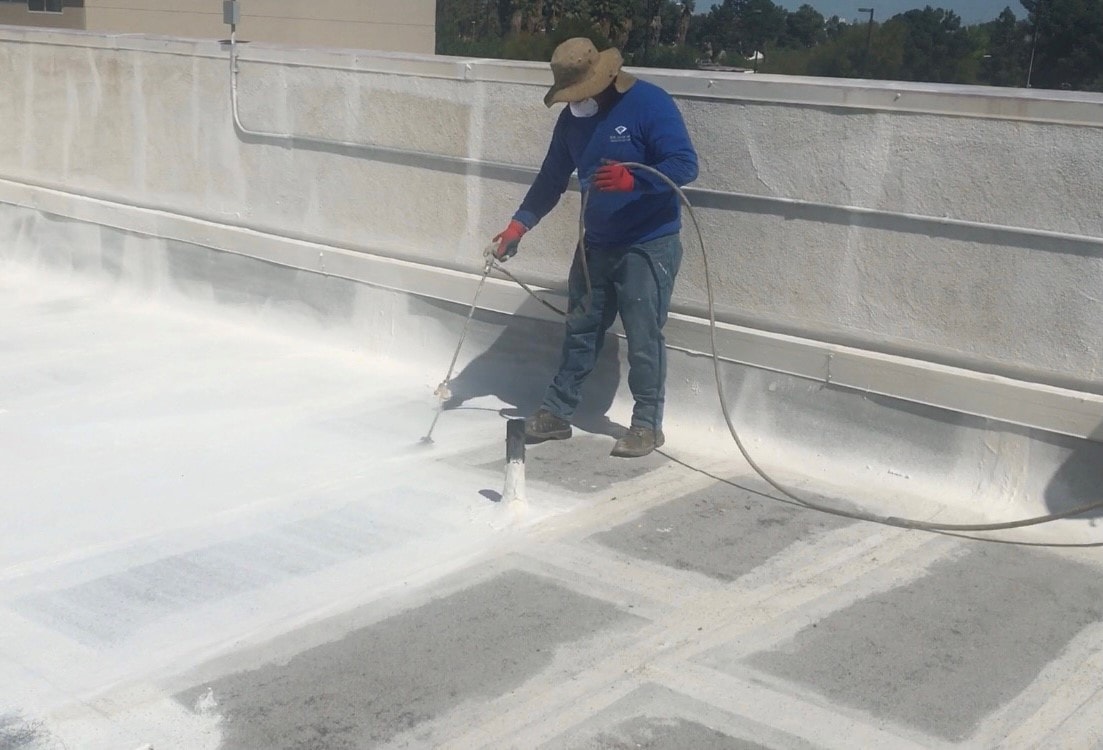
Roof waterproofing in its broadest commercial sense extends well beyond the membrane systems on pitched and flat roofing, it encompasses plaza decks, parking structures, pedestrian bridges, below-grade foundations, and any horizontal or near-horizontal surface where water management is the governing design concern and where the waterproofing assembly bears structural loads rather than simply shedding rain. Lexington has a significant inventory of these structures: the University of Kentucky campus has pedestrian deck systems over occupied spaces, the Rupp Arena district has plaza-level surfaces over structured parking, and the growing mixed-use development around the Distillery District and Greyline Station includes deck waterproofing over occupied retail and residential space. These applications require different products, different detailing, and different design philosophy than standard commercial roofing.
Plaza deck waterproofing operates under conditions that membrane roofing does not face: pedestrian and sometimes vehicular traffic loads, overburden materials including pavers, soil, landscaping, and drainage composites, and the thermal buffering effect of the overburden that moderates temperature swings at the membrane level. The waterproofing membrane itself, typically a hot-applied rubberized asphalt, a cold-applied polyurethane, or a sheet-applied modified bitumen system, is installed beneath the drainage layer and overburden, which means it must perform indefinitely without access for inspection or repair. Getting the detailing right the first time, particularly at drains, expansion joints, and perimeter terminations, is the entire performance argument on a plaza deck installation because there is no practical way to access and repair the membrane after the overburden is in place.
The University of Kentucky campus has several generations of plaza deck and pedestrian bridge waterproofing across its central and medical district areas. Some of these systems date to the 1980s campus expansion period and are showing the performance characteristics of a waterproofing system at or past its design life, intermittent water intrusion into the occupied spaces below, staining on structural concrete soffits, and in some cases localized spalling where freeze-thaw damage has affected the concrete at moisture infiltration points. Diagnosing plaza deck failures on UK campus structures requires thermographic assessment and, in some cases, flood testing of isolated deck sections to confirm failure location before any overburden removal begins. We have experience with this diagnostic process and with the coordination requirements of working on an active university campus where the schedule of the replacement project must accommodate academic calendar constraints.
Parking structure waterproofing in Lexington is a significant maintenance category that property owners often defer until structural consequences become visible. The combination of tire traffic, deicing salt application during Lexington's winter events, and the freeze-thaw cycling that the Bluegrass climate delivers creates an aggressive degradation environment for parking deck waterproofing. Salt penetrates cracked concrete and waterproofing failures, reaches the reinforcing steel, and initiates the corrosion-expansion cycle that produces spalling and structural section loss. A parking structure whose deck waterproofing is allowed to fail systematically will require structural concrete repair as well as waterproofing replacement within ten years of the waterproofing failure, making proactive waterproofing maintenance dramatically cheaper than reactive structural repair.
The limestone geology underlying Fayette County creates specific challenges for below-grade waterproofing on commercial buildings in Lexington. Limestone bedrock, while structurally sound, has karst features, solution channels, voids, and irregular bedrock surfaces, that complicate below-grade drainage design and foundation waterproofing. Water moving through limestone can enter a below-grade foundation system from directions and at rates that a standard below-grade waterproofing assembly wasn't designed to handle, particularly on sites where the bedrock is shallow. We evaluate site-specific subsurface drainage conditions on below-grade waterproofing projects rather than applying a standard system regardless of site conditions.
Expansion joints in plaza decks and parking structures are the most common source of waterproofing failure in these assemblies. An expansion joint is designed to accommodate the thermal movement of the structural system, a parking structure or plaza deck that spans across multiple bays will move measurably with seasonal temperature changes, and the expansion joint provides the designed movement accommodation. The waterproofing at the joint must accommodate the same movement without tearing or debonding. Pre-formed expansion joint assemblies, metal-faced compression seals or reinforced waterproofing bridge strips, are specified based on the joint width and anticipated movement. Field-applied sealant at expansion joints on parking structures is a maintenance measure, not a long-term solution; it fails under the combination of joint movement and traffic loading within a few years of application.
New construction plaza deck and parking structure waterproofing in Lexington should be specified to a standard that reflects the difficulty of future access. The incremental cost difference between a good and excellent waterproofing specification is modest relative to the cost of the structure being waterproofed, and the cost of access for repair, removing pavers, drainage composites, and soil from a plaza deck, or milling the wearing surface from a parking deck, is many times the cost of the waterproofing material itself. We recommend hot-applied systems or premium cold-applied systems with redundant flashing at all transitions and penetrations rather than minimum-specification assemblies on structures where future access will be disruptive and expensive.
Traffic coatings on parking structure decks serve a dual purpose: they protect the concrete substrate from water and chloride penetration, and they provide the wearing surface that resists tire traffic and allows drainage to the drain inlets. Traffic coatings, typically polyurethane-based systems applied in multiple layers with aggregate broadcast for slip resistance, need to be maintained on a cycle that keeps the wearing surface intact. A worn or delaminated traffic coating exposes the concrete directly to salt and water, initiating the degradation sequence that eventually reaches the reinforcing steel. We assess traffic coating condition on parking structure maintenance visits and recommend recoating on a cycle that prevents exposure of the substrate rather than waiting for visible concrete deterioration to trigger the work.
Green roof assemblies, vegetated roof systems over occupied spaces, are an emerging application in Lexington's urban commercial development, particularly in the Greyline Station mixed-use district and on new construction around the University of Kentucky medical corridor. A green roof is fundamentally a plaza deck application with an added moisture retention layer and growing medium. The waterproofing design for a green roof must account for root penetration resistance, permanent saturated conditions, and the fact that the planted overburden makes future access even more disruptive than a paver-surfaced plaza deck. Root-resistant waterproofing membranes and properly designed drainage composites beneath the growing medium are the critical specifications that determine whether a Lexington green roof performs for its design life or requires disruptive overburden removal and membrane replacement within a decade.
Questions Owners Ask
How is plaza deck waterproofing different from standard roofing?
Plaza deck waterproofing is installed beneath an overburden of pavers, drainage composite, and sometimes soil, it bears structural loads and is not accessible for inspection or repair without removing the overburden. Standard roofing membranes are exposed and accessible. This inaccessibility means plaza deck waterproofing systems must be specified for the full design life without maintenance access, and the detail execution at drains, joints, and penetrations must be correct the first time.
My parking structure deck is showing cracks and staining on the soffit, is this a waterproofing problem?
Staining and spalling on the underside of a parking deck is typically the visible result of chloride-initiated reinforcing steel corrosion, which is caused by water and deicing salt penetrating through failed waterproofing or cracked concrete. This condition indicates waterproofing failure has been occurring for some time, and the structural concrete repair scope is likely more significant than the waterproofing replacement scope. Early assessment and repair of parking structure waterproofing prevents the structural deterioration that creates the more expensive scenario.
Can below-grade foundation waterproofing be repaired from the interior?
Interior-applied crystalline waterproofing treatments can reduce moisture infiltration through existing below-grade concrete, but they are not equivalent to proper exterior waterproofing. Interior treatments work by filling concrete pores and micro-cracks with crystalline growth that blocks water movement, but they don't address the root cause of infiltration and are not effective against hydrostatic pressure water entry through larger cracks or joint failures. Exterior waterproofing, which requires excavation to expose the foundation, is the definitive solution for significant below-grade moisture intrusion.
What causes expansion joint failures in parking structures?
Expansion joints fail when the sealant or prefabricated joint assembly can no longer accommodate the thermal movement of the structure while maintaining a watertight seal. Field-applied sealant deteriorates from UV exposure, traffic loading, and joint movement, typically within three to five years. Prefabricated joint assemblies last longer but eventually fatigue from repeated movement cycles. Joints that are cleaned, inspected, and maintained on a regular cycle last significantly longer than joints that are ignored until visible failure triggers a repair call.
Does Lexington's limestone bedrock affect waterproofing design?
Yes, on sites with shallow bedrock. Karst features in limestone, solution channels and voids, can create subsurface drainage paths that concentrate water movement against below-grade foundations in ways that aren't predictable from surface observations alone. We evaluate subsurface drainage conditions on below-grade waterproofing projects and design the drainage composite and waterproofing assembly to manage site-specific conditions rather than applying a standard system without site investigation.