
Roof Drains Scuppers in Lexington, KY from Commercial Roofing of Lexington.
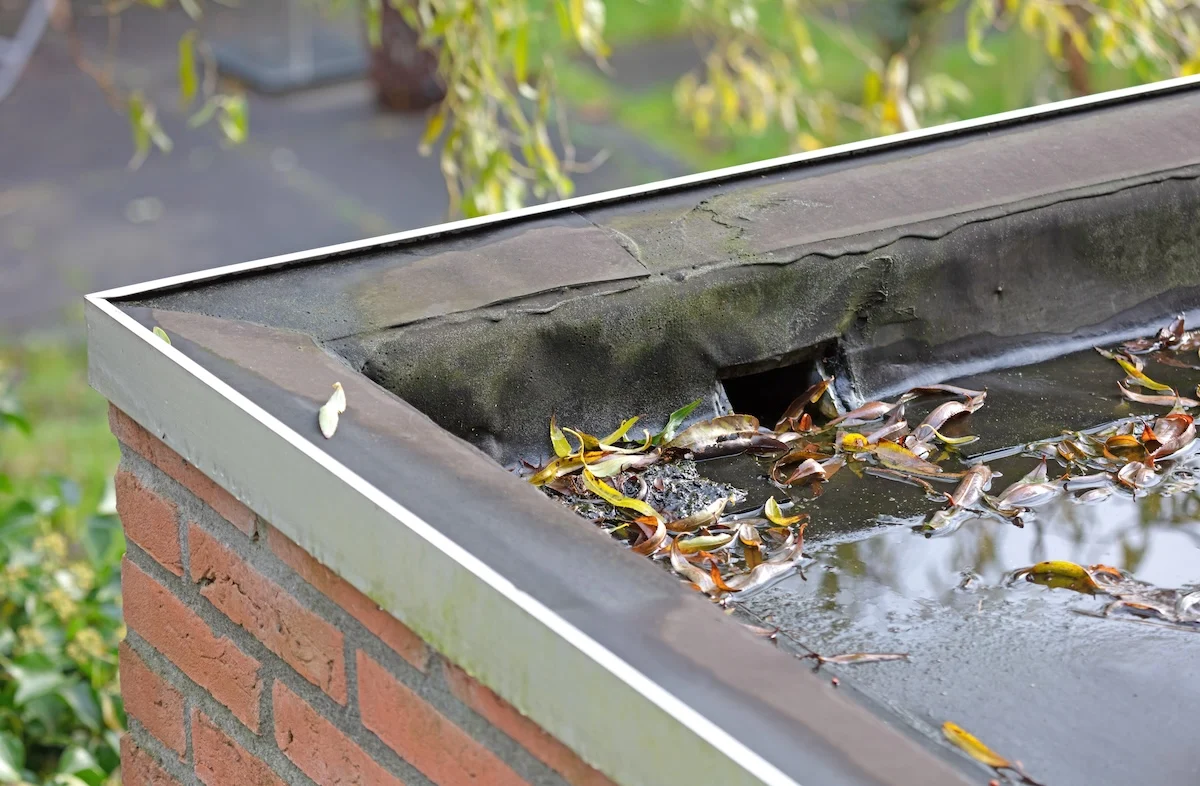
Roof drainage is one of the most technically consequential decisions in commercial roofing design, and on Lexington's flat commercial buildings it is frequently under-engineered relative to the precipitation intensity the city actually experiences. Lexington averages just under 50 inches of annual precipitation, with May and July each delivering more than five inches in a month that includes peak convective storm events capable of depositing two inches or more in a single hour. A flat commercial roof that can't evacuate water faster than it accumulates is a building that chronically ponds, and chronic ponding shortens membrane service life, stresses the structural deck, and creates interior leak risk at every low point. Getting drain sizing and placement right is not a theoretical exercise, it's the difference between a roof that performs for 25 years and one that needs premature replacement.
The hydraulic calculation for roof drain sizing accounts for three variables: contributing roof area per drain, design storm intensity for the geographic location, and the flow capacity of the drain at the design ponding depth. Lexington falls in a rainfall intensity zone that requires drain sizing for roughly 4 to 5 inches per hour at the 10-year storm standard used for most commercial design. A single 4-inch diameter roof drain has a flow capacity of approximately 50 gallons per minute at one inch of ponding depth, adequate for roughly 1,000 to 1,200 square feet of contributing area at Lexington's design intensity. Commercial buildings with drains serving 5,000 or 10,000 square feet of contributing area per drain, not uncommon on older Lexington commercial buildings that were designed to less rigorous standards, are structurally undersized for the loads they see during significant storm events.
Legacy Business Park and Coldstream Research Campus contain some of the largest flat roof planes in Fayette County. Buildings on these campuses can exceed 200,000 square feet under a single low-slope roof, with interior drain configurations that were designed during the original construction permit process and may not have been revisited since. When we conduct drainage assessments on these buildings, we calculate the contributing area per drain, compare it to the design standard, and flag undersized drain configurations for the property manager's capital planning consideration. Adding drains to a large commercial roof is not a trivial undertaking, it requires core drilling through the deck and coordinating with the building's internal plumbing system, but it's far less disruptive than managing the accelerated membrane wear and structural deck stress that chronic ponding causes.
Scuppers, open through-wall drainage openings at the parapet perimeter, serve a different role in Lexington commercial drainage than interior drains. Primary scuppers provide through-wall drainage on buildings where the roof slopes to the perimeter rather than to interior drains. Emergency overflow scuppers, which are sized and positioned to drain the roof if interior drains become clogged, are a life-safety requirement on most commercial flat roofs under the current International Building Code. An emergency overflow scupper should be positioned 2 inches above the primary drainage level so that it activates only if the primary system fails, and it should discharge away from the building face in a way that is visible, a scupper that overflows visibly tells the building operator that the primary drains are blocked. We assess emergency overflow scupper presence and positioning on every drainage audit and note their absence as a code compliance deficiency where applicable.
The limestone geology underlying most of Fayette County creates a specific drainage consideration for commercial buildings on sites with shallow bedrock: subsurface drainage and foundation drainage patterns that differ from sites with deep soil profiles. While this primarily affects site drainage rather than roof drainage, it becomes relevant when roof drain discharge connects to underground storm systems that must navigate the limestone substrate. We coordinate with site civil engineers on projects where roof drain discharge modifications require subsurface routing, ensuring that the drainage pathway from the roof drain to the storm system is hydraulically continuous and doesn't create ponding risk at the building foundation perimeter.
Drain bowl condition is a maintenance item that many commercial building owners overlook until a drain fails during a storm event. The cast iron or composite drain body can corrode or crack over decades of service, particularly on older buildings where the drain body has been subjected to impact from drain cleaning equipment or frozen water in the bowl. The clamping ring, which secures the membrane to the drain flange, corrodes independently of the drain body and may lose its clamping force before the drain body itself fails. We inspect drain bowls and clamping hardware on every maintenance visit and replace hardware that is corroded or functionally compromised. A failed clamping ring that allows the membrane to lift away from the drain flange is an active leak waiting for the next heavy rain.
Retrofit drain additions on existing commercial buildings require coordination between the roofing scope and the building's plumbing infrastructure. Adding a roof drain to a large flat roof at Legacy Business Park or on a UK campus building means identifying a routing path for the drain leader from the roof level to the storm system connection, through a concrete deck, through the building structure, and to a point where it can tie into the existing storm drainage piping. The roofing contractor manages the through-deck sleeve and the membrane integration; the plumbing contractor handles the drain leader installation. We coordinate this scope carefully on drain addition projects rather than assuming the plumbing side will sort itself out independently.
Roof drain strainer maintenance is a basic but frequently deferred task on Lexington commercial buildings. A leaf-clogged drain strainer on a flat roof during a storm event converts that drain from a functioning drainage point to an obstruction, backing up water across the roof plane until the strainer is cleared. Lexington's mature urban tree canopy, particularly in established commercial districts like Chevy Chase and around the UK campus, generates significant leaf load on commercial roofs in the fall. We schedule drain cleaning as a standard fall maintenance task on every commercial building we service, and we recommend property managers also check drain strainers after wind events that deposit debris on the roof between scheduled maintenance visits.
Through-wall scupper flashing is one of the most commonly failed details on historic Lexington commercial buildings with masonry parapets. A scupper opening cut through a masonry parapet wall requires a sheet metal liner that connects the roof membrane to the scupper opening, sealed at the back of the scupper and the sides of the wall opening. When this liner fails, from corrosion, from separation at the membrane connection, or from improper original installation, water that should exit through the scupper instead enters the parapet wall. We see this condition frequently on Warehouse Block buildings and older Distillery District commercial properties, where scupper liners installed decades ago have deteriorated without systematic maintenance attention.
Questions Owners Ask
How do I know if my building has enough roof drains?
The simplest indicator is chronic ponding, if your roof holds significant water for more than 48 hours after a rain event, drainage capacity is likely inadequate for the roof area. For a technical assessment, we calculate the contributing area per drain, compare it to the hydraulic capacity at Lexington's design storm intensity, and identify whether the configuration meets current standards. Many older Lexington commercial buildings are significantly undersized by current criteria.
What is an emergency overflow scupper and does my building need one?
An emergency overflow scupper is a through-parapet opening positioned slightly above the primary drainage level that activates if interior drains become clogged, preventing catastrophic ponding that could exceed the structural deck's load capacity. The International Building Code requires emergency overflow drainage on most commercial flat-roof buildings. Many older Lexington commercial buildings were constructed before this requirement was standard, and we note the absence of emergency overflow provisions as a deficiency during drainage audits.
Why does my roof pond after rain even though the drains aren't clogged?
Ponding with open drains indicates that either the drain capacity is insufficient for the contributing roof area, the roof surface doesn't slope adequately to move water to the drains, or both. Many older Lexington commercial buildings have structural decks that are essentially flat, relying entirely on drain placement to evacuate water. If the deck has deflected slightly over time or the original slope was minimal, water will sit in low areas even with functional drains. Tapered insulation systems that create positive slope to the drains are the most effective correction for this condition during a re-roofing project.
Can roof drains be added to an existing building?
Yes, though the scope involves both roofing and plumbing work. The roof drain body is installed through a core-drilled opening in the deck, the membrane is integrated at the drain flange, and a drain leader is routed through the building structure to connect to the storm drainage system. The feasibility and cost depend on the building's structural configuration and the routing path available for the drain leader. We assess these constraints before proposing a drain addition scope.
How often should roof drains be cleaned?
At minimum annually, ideally in the fall before the winter freeze season, to remove accumulated leaf and debris load. Buildings under deciduous tree canopy, common in Lexington's established commercial districts, may need cleaning twice annually, in fall and spring. Clogged drains during a Lexington storm event can create ponding depths significant enough to stress the structural deck, making drain cleaning one of the highest-return maintenance tasks on a flat commercial roof.