
Insulation Recovery Board in Lexington, KY from Commercial Roofing of Lexington.
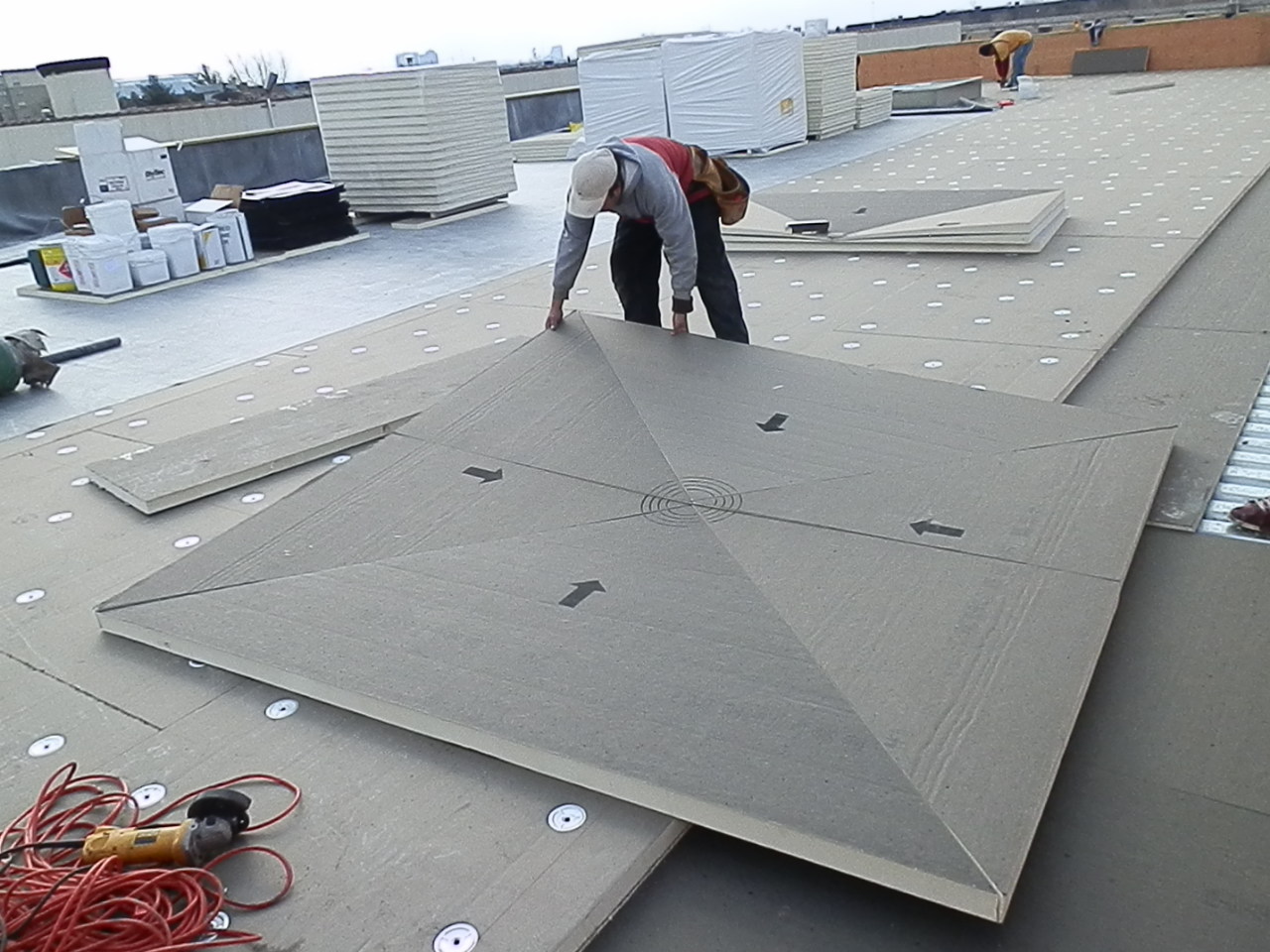
Insulation and recovery board are the components of a commercial roofing assembly that building owners see the least and understand the least, but they represent decisions with the longest financial consequences of anything in the re-roofing scope. Getting the insulation specification right on a Lexington commercial building means the difference between a roof that meets minimum code and one that meaningfully reduces energy costs for the next 25 years. Getting it wrong means trapping moisture, losing R-value to thermal bridging, or specifying a product that degrades in Lexington's climate before the membrane above it fails.
Polyisocyanurate, iso board, is the dominant insulation product in commercial roofing in Lexington and throughout the central Kentucky market. It delivers the highest R-value per inch of any commercially available rigid insulation, typically around R-6 per inch at initial installation, which makes it efficient in terms of assembly height. The complication with iso in Lexington's climate is the phenomenon known as thermal drift and cold-weather R-value reduction. Iso board loses a portion of its rated R-value at low temperatures, the foaming gases in the closed cells condense slightly in cold conditions, reducing the insulating effectiveness of the product when it's needed most. In Lexington's heating season, with nearly 90 freezing-degree nights annually, this matters for the thermal performance argument. We specify iso with an appropriate aging-R credit in our calculations rather than using the initial labeled R-value for energy savings projections.
Recovery board is a separate product from insulation, though the terms are sometimes used interchangeably in contractor conversations. A recovery board, typically a half-inch or quarter-inch board of high-density polyiso, wood fiber, or gypsum, serves as a separation and surfacing layer between the existing roofing assembly and the new membrane in a recover project. It provides a smooth, stable substrate for the new membrane, distributes fastener pullout loads, and gives the new membrane a clean bonding surface that isn't contaminated by the oxidized and weathered surface of the old membrane. On Legacy Business Park office buildings with dry insulation that qualifies for a recover approach, properly specified recovery board is the component that makes the difference between a new membrane that performs to its design life and one that shows premature fastener back-out or membrane wrinkle patterns from substrate irregularity.
The International Building Code limits commercial buildings to two roofing assemblies, the original system and one recover. A building at Beaumont Centre that already had its original built-up roof recovered with a single-ply membrane 15 years ago has reached that limit. The next re-roofing project is a full tear-off, and one consequence of that tear-off is the opportunity to specify fresh insulation at current code requirements. This is also the moment when an owner can address insulation deficiencies that have accumulated, settled insulation, wet areas that needed removal, or original insulation that was specified below current code minimums, without the constraint of working around existing assemblies.
Current Kentucky energy code (based on ASHRAE 90.1 and the International Energy Conservation Code) sets minimum insulation requirements for commercial roofing in climate zone 4, which covers Lexington and Fayette County. The minimum requirements have increased significantly over successive code cycles, buildings reroofed today need substantially higher R-values than those constructed in the 1990s. We design insulation assemblies to current code as a minimum, and we recommend that owners evaluate the economics of exceeding code minimums on buildings where the insulation assembly is being completely replaced. The incremental cost of adding one additional layer of 2-inch iso board is modest relative to the full project cost; the energy savings over 25 years of system life are not modest.
Tapered insulation systems deserve attention on Lexington commercial buildings where positive drainage cannot be achieved through structural slope alone. Many older flat commercial buildings in Lexington, particularly 1960s and 1970s construction on the UK campus and in older commercial districts, have structural decks that are functionally flat, with drainage achieved entirely through drain placement rather than slope. On these buildings, a tapered iso assembly that slopes the insulation from a high point at the center of each bay to the drain location provides the slope needed for positive drainage at a fraction of the cost of structural modification. Tapered iso is also the correct solution when a recover or replacement project needs to address the chronic ponding that is degrading membrane performance in low areas.
Moisture in insulation is the condition that invalidates both the recover option and the thermal performance argument for existing insulation. Wet iso board loses virtually all of its R-value, saturated polyisocyanurate conducts heat rather than resisting it. Wet insulation also creates a reservoir that continues to degrade the materials above and below it long after the original water entry point is repaired. We conduct infrared moisture scans and core sampling to map wet insulation areas on every project where recover or insulation preservation is being considered. The core sample tells us not just whether the insulation is wet but how wet, saturated insulation that has lost structural integrity must be removed regardless of the economic argument for recovery.
Fastener selection for mechanically attached insulation systems in Lexington requires attention to the structural deck type. Steel decks, concrete decks, wood decks, and lightweight concrete decks each require different fastener types and patterns to achieve the required uplift resistance for central Kentucky's design wind speeds. Over-driven fasteners that compress the insulation board create thermal bridges that reduce effective R-value at every fastener location, a significant cumulative effect on large commercial roofs with high fastener density. Under-driven fasteners don't achieve their rated pullout resistance. We specify fastener type, pattern, and installation torque requirements in every insulation specification and verify installation quality during the work rather than assuming it.
The insulation conversation for Coldstream Research Campus buildings and UK HealthCare facilities involves one additional layer of complexity: the thermal performance of the roof assembly relative to the building's HVAC design. Research buildings and medical facilities with high internal heat loads and precise humidity control requirements have different roof thermal performance sensitivities than office or retail buildings. We coordinate with the building's mechanical engineering baseline when we're advising on insulation specifications for these buildings, ensuring that our recommendations are consistent with the building's design intent rather than simply meeting minimum code requirements.
Questions Owners Ask
What insulation R-value does Lexington's energy code require for commercial roofs?
Lexington is in climate zone 4 under the International Energy Conservation Code. Current minimum requirements for continuous insulation on commercial roofing are in the R-20 to R-25 range depending on the roof assembly type and the building occupancy classification. Code requirements have increased significantly over recent cycles, so buildings built before 2010 are almost certainly below current minimums. We design to current code as a baseline and recommend considering higher R-values when the full assembly is being replaced.
Can wet insulation be dried out and reused?
No. Polyisocyanurate insulation that has been saturated cannot be effectively dried and reinstalled. The foam cell structure degrades when wet, and even if surface drying is achieved, the internal cell structure has been compromised and the R-value will not recover. Wet insulation sections identified by infrared scan and core sampling must be cut out and replaced with new material.
What is tapered insulation and when does my building need it?
Tapered insulation is a system where the insulation boards are cut at varying thicknesses to create a slope from a high point to the roof drains. It's used when a building's structural deck is flat or has insufficient slope for positive drainage. Buildings with chronic ponding, where water sits for more than 48 hours after rain events, are strong candidates for tapered insulation systems during re-roofing, since adding structural slope would require significant and expensive modifications to the building structure.
What's the difference between recovery board and new insulation?
Recovery board is a thin, high-density surfacing layer installed over the existing roofing assembly in a recover project. It provides a stable, smooth substrate for the new membrane without contributing significant R-value. New insulation is full-thickness board, typically 2 to 4 inches or more of polyisocyanurate, that provides the thermal resistance. In a tear-off and replacement project, new insulation is specified. In a recover project where the existing insulation is dry, recovery board brings the substrate to the proper surface quality for the new membrane.
Does adding insulation require a building permit in Lexington?
Re-roofing projects in Lexington typically require a building permit from the Lexington-Fayette Urban County Government's Division of Building Inspection. The permit requirement covers the full roofing scope including insulation. Permit requirements ensure that the insulation specification meets current energy code minimums. We handle permit applications as a standard part of our project process and can advise on what documentation is required for the specific project type.