
Commercial Roofing in Lexington, KY from Commercial Roofing of Lexington.
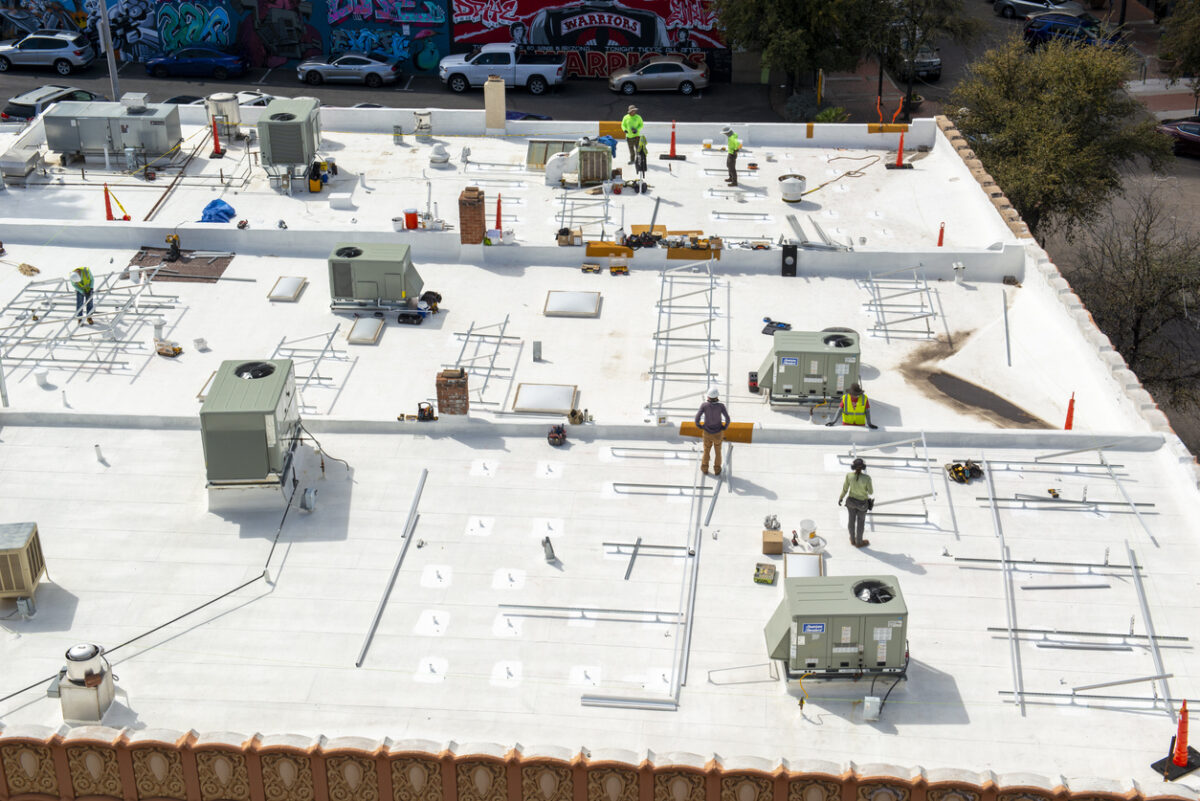
Commercial roofing in Lexington, Kentucky is shaped by two forces that don't always get discussed together: a building stock with unusual depth and variety, and a climate that tests every roofing system in distinct ways across every season. Lexington is not a one-system market. The city has 1960s-era university buildings with original built-up roofing, 1980s strip retail with torch-applied modified bitumen, Coldstream Research Campus life-science buildings with premium single-ply, auto-supplier facilities along Georgetown Road with standing seam metal, and Warehouse Block historic conversions with masonry parapets and improvised roofline additions from three different renovation eras. Serving this market well means being genuinely competent across all of these systems, not just marketing a preferred product to every customer who calls.
The Bluegrass climate imposes real performance demands. Lexington averages just under 50 inches of annual precipitation, with May and July each delivering concentrated rain events that test drainage design and membrane integrity simultaneously. The city records nearly 90 freezing-degree nights per year alongside 25-plus days above 90°F, that seasonal swing drives thermal movement in metal systems, stresses lap seam adhesives in EPDM and modified bitumen, and cycles water in and out of any open flashing detail repeatedly through the winter and spring. Freeze-thaw cycling is the specific mechanism behind more Lexington commercial roof failures than any single weather event, because it operates slowly and invisibly until the cumulative damage crosses a threshold.
The University of Kentucky campus is one of the most complex commercial roofing environments in central Kentucky. With 26,846 employees, dozens of buildings across academic, research, athletics, and medical uses, and a facilities management organization that plans capital expenditures years in advance, UK represents the kind of institutional client where technical credibility and documentation quality matter as much as price. UK HealthCare's medical district on and near Limestone Street has its own layer of complexity, occupied patient care buildings where roof work requires coordination with infection control protocols, sterile environment requirements, and facility leadership that cannot absorb unplanned disruptions.
Coldstream Research Campus, at 735 acres with 1.74 million square feet of developed space and roughly 2,250 employees, is Lexington's premier research and light-manufacturing district. The tenant mix, life sciences, technology, defense contractors including Lockheed Martin, and specialty manufacturing, creates roofing challenges that go beyond standard commercial work. Chemical exhaust penetrations, clean-room environments with tight humidity tolerances, and research-grade equipment stored directly beneath roof assemblies all raise the stakes on installation quality and leak prevention. We treat Coldstream buildings as mission-critical environments, not standard commercial jobs.
The retail corridor from Fayette Mall through Hamburg Pavilion to the Summit at Fritz Farm and Beaumont Centre represents a different commercial roofing profile, large flat roofs, high HVAC density for retail conditioned space, restaurant exhaust penetrations that create grease contamination zones on surrounding membrane, and property management structures where decisions flow through regional or national asset managers rather than local ownership. Working effectively in this environment means understanding how to document conditions, submit repair proposals, and obtain approvals through property management chains that may be headquartered outside Kentucky.
The industrial and logistics corridor along I-75, I-64, and Newtown Pike, including the Amazon distribution facility in Fayette County, auto-supplier buildings feeding the Toyota Georgetown plant, and the distribution infrastructure around Blue Grass Airport, operates at a different scale and rhythm than office or retail commercial. These buildings have large unobstructed roof planes, relatively straightforward drainage patterns, and maintenance needs that center on metal panel and fastener condition rather than complex flashing details. But the consequence of a roof failure at an active distribution or manufacturing facility, production stoppage, inventory damage, worker safety implications, creates urgency around maintenance that building operators in less time-sensitive uses may not feel as acutely.
Service selection in Lexington's commercial market should be driven by building condition assessment, not by which system a contractor happens to prefer installing. A building with dry insulation, sound membrane, and isolated flashing failures is a maintenance and repair candidate, not a replacement candidate. A building with widespread wet insulation and a membrane at end of service life needs replacement, not another round of patches. A building with sound membrane in the middle of its service life and a history of drain overflow during heavy rain events needs a drainage engineering solution alongside whatever membrane work is indicated. We structure our service recommendations around the honest condition of each building because that's how we build relationships with property owners and managers who need a contractor they can trust over a long engagement.
Contractor selection criteria for Lexington commercial roofing should include manufacturer certifications (which determine warranty coverage levels), verifiable local project references in the specific building type you're managing, documented safety programs for occupied-building work, and financial stability adequate to support a warranty obligation over a 15- to 25-year system life. The lowest bid from a contractor who cannot document these qualifications is a risk, not a savings. In a market with significant seasonal contractor migration, crews that follow work across the region, the ability to verify local project history and stable business continuity matters to building owners who need warranty support years after installation.
We work across every service type the Lexington commercial roofing market requires: inspection, maintenance, repair, recover, replacement, coating, waterproofing, and emergency response. Our goal is to be the contractor a Lexington facility manager or building owner calls first, not because we've outspent competitors on marketing, but because our assessments are honest, our work is technically sound, and our documentation gives them what they need to manage their roofing assets with confidence over the long term.
Questions Owners Ask
What types of commercial roofing systems do you install in Lexington?
We install and maintain all major commercial low-slope roofing systems, TPO, EPDM, PVC, KEE, modified bitumen (SBS and APP), built-up roofing, spray polyurethane foam, and commercial metal roofing including standing seam and R-panel. We also apply roof coatings and perform waterproofing for plaza decks and below-grade applications. System selection is based on the specific building's requirements, not on which product we prefer to install.
Do you work on both large and small commercial buildings?
Yes. Our project range in Lexington includes everything from small professional office buildings and neighborhood retail to multi-wing hospital campuses and large research and industrial facilities at Coldstream and Legacy Business Park. The project management approach scales to the building, a 5,000-square-foot repair is executed with the same attention to quality and documentation as a 200,000-square-foot replacement.
How do Lexington's weather patterns affect my commercial roof?
Lexington's combination of heavy May and July precipitation, 25-plus summer days above 90°F, and nearly 90 annual freezing nights creates a demanding performance environment. Freeze-thaw cycling is particularly hard on lap seam adhesives, flashing sealants, and any open penetration detail. The heavy spring and summer rain events test drainage capacity and expose marginal flashing conditions that perform adequately in normal precipitation. We factor these climate specifics into every assessment and specification recommendation.
What should I look for when selecting a commercial roofing contractor in Lexington?
Manufacturer certifications for the system you're considering, verifiable local references on buildings similar to yours, a documented safety program, clear warranty terms, and financial stability. Ask specifically whether the contractor carries workers' compensation and general liability insurance with limits appropriate for your building's value. A certificate of insurance naming your building as an additional insured should be provided before any work begins.
Do you provide emergency roofing services in Lexington?
Yes. We respond to active leak events, storm damage, and other roofing emergencies on commercial buildings across Lexington and Fayette County. For hospital, medical, and critical-use facilities, we maintain priority response capability. Contact us directly for emergency situations rather than through the website inquiry form, and we will get back to you immediately.